How Much Revenue Are You Losing from E/M Undercoding? A Calculator for Physicians
Introduction
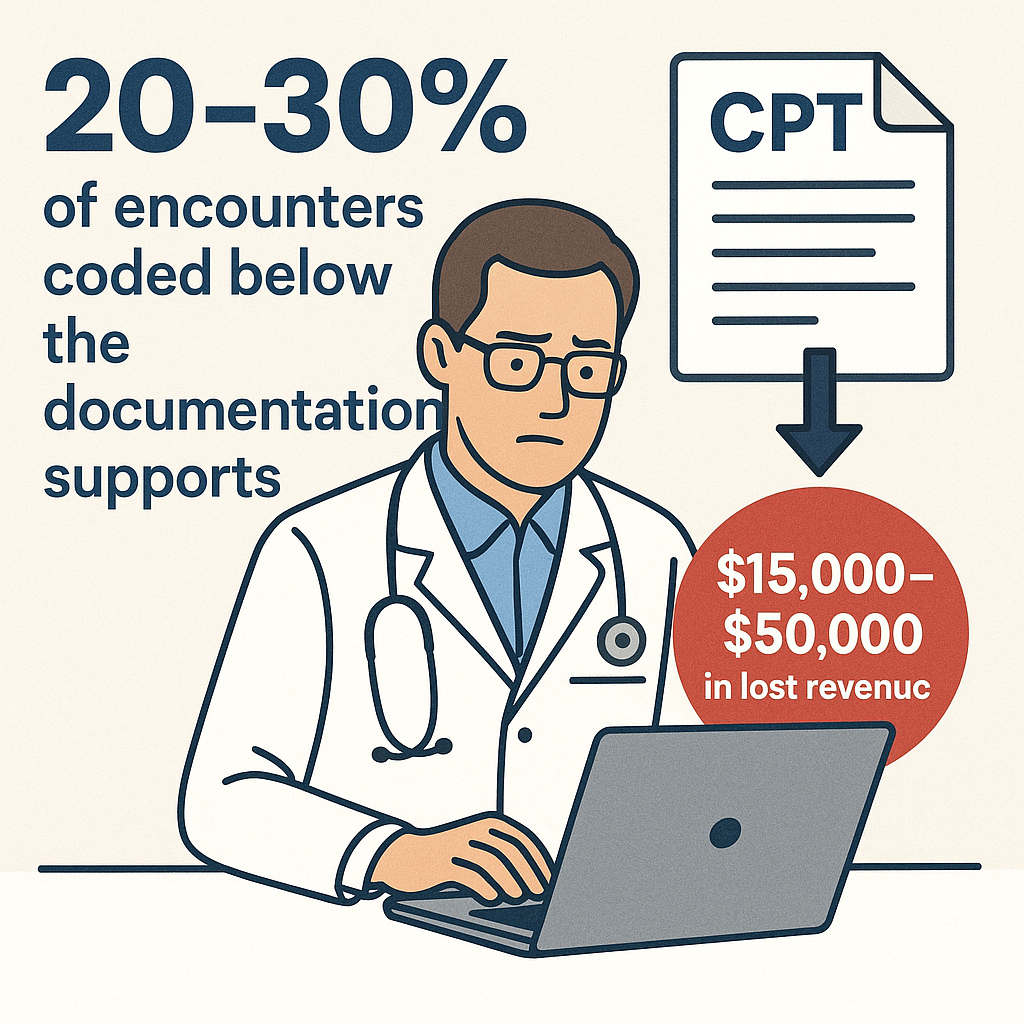
Here is a number that should concern every practicing physician: studies consistently show that 20–30% of evaluation and management encounters are coded below the level that the clinical documentation supports. For an individual physician, that translates to $15,000–$50,000 in lost revenue every year — not from payer downcoding or claim denials, but from selecting a lower CPT code than the chart justifies.
The culprit is not carelessness. It is the sheer complexity of the E/M coding framework — a system that changed significantly in 2021, was updated in 2023, and changed again in 2025. Most physicians received zero formal training on medical billing in residency, and the MDM matrix that drives E/M code selection is one of the most intricate billing structures in all of medicine.
This article breaks down the real financial impact of E/M undercoding, explains why it happens, and introduces a dual-method AI approach that calculates the correct code in seconds.
The Hidden Cost of Playing It Safe
When a physician is uncertain whether a visit meets the threshold for a 99214 or a 99215, the overwhelming instinct is to code down. It feels safer. The reasoning is understandable: downcoding feels conservative, and nobody gets audited for billing less.
But that instinct has a real cost. Physicians undercode for several consistent reasons:
Fear of audits. The specter of RAC audits, MAC reviews, and OIG investigations creates a chilling effect. Physicians code defensively rather than accurately — and defensive coding almost always means lower codes.
Complexity of the MDM matrix. Medical Decision Making has three elements — Number and Complexity of Problems Addressed, Amount and Complexity of Data Reviewed, and Risk of Complications. Each element has its own multi-level scoring rubric. Two of three must meet the threshold for a given code level. It is genuinely difficult to hold this matrix in your head during a busy clinic day.
Time pressure. With 15-minute appointment slots and a waiting room that never empties, spending an extra two minutes analyzing whether your documentation supports a 99215 feels like a luxury you cannot afford.
Lack of training. Medical schools and residency programs teach medicine, not billing. Most physicians learn E/M coding through trial and error, brief in-services, or the occasional compliance lecture — none of which build the fluency required for accurate real-time code selection.
The Math Behind Your Lost Revenue
Let us look at the numbers using 2026 Medicare Fee Schedule rates for established patient office visits:
99213 (Low complexity): approximately $98
99214 (Moderate complexity): approximately $128
99215 (High complexity): approximately $173
The difference between a 99213 and a 99214 is roughly $30. The difference between a 99214 and a 99215 is roughly $45. These are not trivial numbers when multiplied across a physician’s schedule.
Scenario 1: A physician undercodes 2 visits per week from a 99214 to a 99213. That is $60/week × 50 weeks = $3,000/year in lost revenue from just two visits per week.
Scenario 2: A physician undercodes 3 visits per week from a 99215 to a 99214. That is $135/week × 50 weeks = $6,750/year.
Scenario 3: Combine both patterns — which is common — and the annual impact easily reaches $10,000–$20,000. For specialists with higher-complexity visits and commercial payer rates that exceed Medicare, the number climbs to $30,000–$50,000.
The irony: upgrading just 2 visits per month from a 99214 to a 99215 — when the documentation supports it — generates over $1,000 in additional annual revenue. That alone more than covers the cost of a coding accuracy tool.
Why Traditional Solutions Fall Short
Manual coding matrices are the most common approach. Laminated cards, pocket references, EHR-embedded decision trees. They work in theory, but in practice, they add friction to every encounter and still require the physician to interpret the MDM elements correctly under time pressure.
External coding auditors provide valuable retrospective analysis, but they are expensive ($50–$150 per chart review), slow (results come weeks later), and purely backward-looking. They tell you what you coded wrong last quarter — not what you should code right now.
Most AI coding tools on the market were built by software engineers and data scientists who understand machine learning but have never sat across from a patient. They often lack clinical nuance, cannot account for the subtleties of MDM element scoring, and do not understand how physicians actually document.
A Better Approach: Dual-Method AI Coding
E/M-Code-Sense AI takes a fundamentally different approach. Built by Dr. Peter R. Jensen, MD, CPC — a practicing physician and certified professional coder with 20+ years of E/M expertise — it was designed from the exam room, not the engineering lab.
The platform simultaneously calculates both MDM-based and Time-based E/M codes for every encounter, then delivers the highest justified CPT code. This dual-method approach ensures no billable complexity goes uncaptured, regardless of which calculation method favors the physician.
Key capabilities include:
Pre-Flight PHI Scrubber: All 18 HIPAA Safe Harbor identifiers are stripped locally before any clinical text reaches the AI engine. Patient names, dates, SSNs, MRNs — removed on your device. Your patients’ data never touches the AI.
Audit-Defensible Rationale: Every code comes with a detailed rationale explaining which MDM elements were met and how the time calculation maps to the CPT code. One click copies it directly into Epic, Cerner, or any EHR.
Financial Insights: The platform shows exactly how close your documentation is to the next billing tier and calculates the revenue impact of coding at each level using current Medicare Fee Schedule rates.
Undercoding Prevention: When your documentation supports a higher code than the one you might typically select, E/M-Code-Sense AI flags it — with the clinical evidence to back it up.
Conclusion: Know Your Number
Every physician has a number — the annual revenue gap between what they bill and what their documentation supports. For most, that number is somewhere between $15,000 and $50,000.
The documentation is already in the chart. The clinical complexity has already been managed. The only missing piece is a tool that translates that work into the correct code — instantly, accurately, and defensibly.
Try your first 15 charts free — no credit card required. See exactly how much revenue you are leaving on the table.