

Introduction
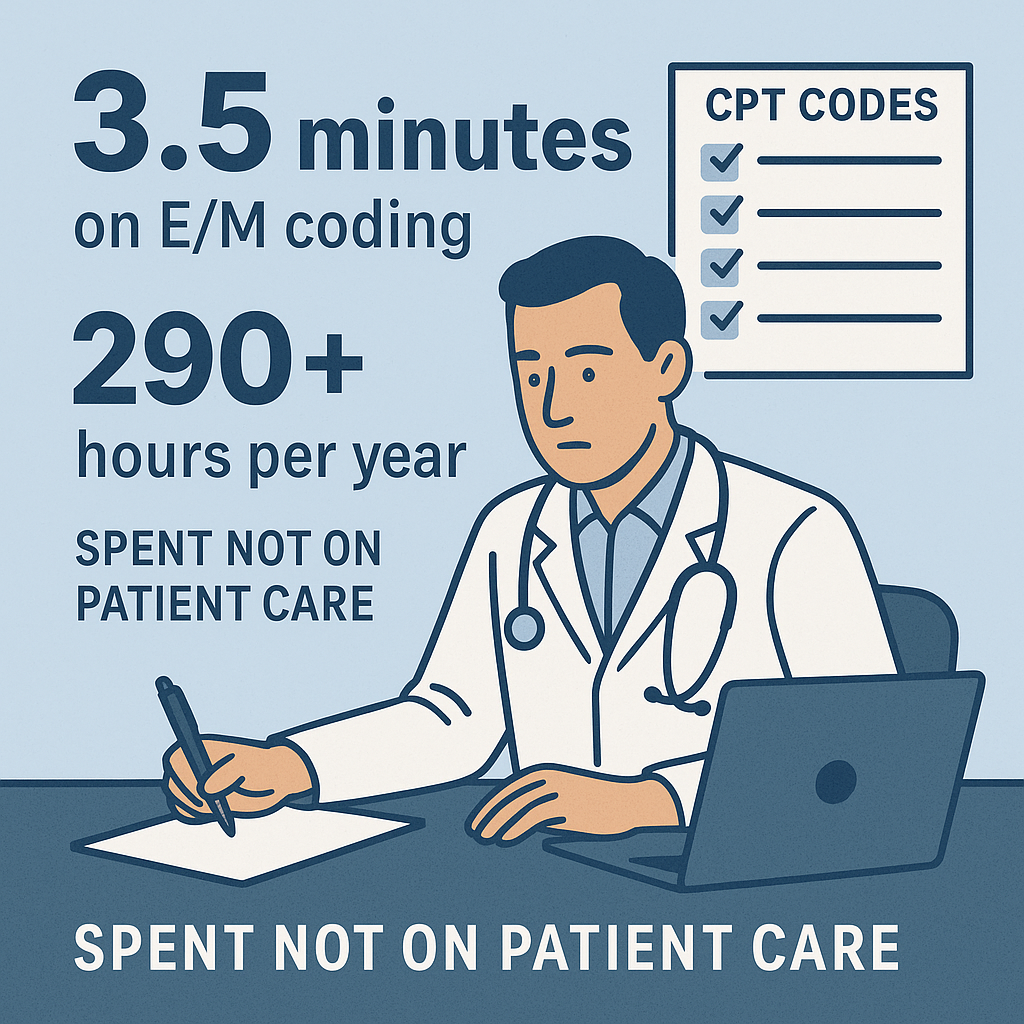
The average physician spends 3.5 minutes on every E/M coding decision.
That might not sound like much — until you do the math.
At 20 patients per day, that’s 70 minutes spent on coding alone. Over a 250-day clinical year, that adds up to more than 290 hours — the equivalent of over seven 40-hour work weeks — spent not on patient care, not on clinical decision-making, but on selecting CPT codes.
This is time that could be spent with patients. Time that could be spent finishing documentation before leaving the clinic. Time that could be spent on continuing education, research, or simply going home.
E/M coding is one of the most repetitive, time-intensive administrative tasks in clinical practice. And for most physicians, it’s also one of the most uncertain — because the vast majority never received formal training in how to do it.
That’s about to change.
The Complexity Behind Those 3.5 Minutes
To understand why E/M coding takes so long, you have to understand what’s actually happening in those 3.5 minutes.
The Medical Decision Making (MDM) method requires evaluating three elements: the number and complexity of problems addressed, the amount and complexity of data reviewed and analyzed, and the risk of complications, morbidity, or mortality associated with the management decisions. Each element has multiple levels, and the final E/M code is determined by the two highest-qualifying elements.
Then there’s time-based coding — an alternative method that became available for all outpatient E/M visits with the 2021 guideline changes. Under this method, the total physician time for the encounter (including face-to-face and non-face-to-face activities on the date of service) maps to a specific CPT code.
Most physicians don’t calculate both. Many don’t even realize time-based coding is an option. And those who do often aren’t sure which method yields a more accurate result for a given encounter.
Add to this the fact that the MDM framework was substantially revised in 2021, updated again in 2023, and modified once more in 2025 — and it becomes clear why physicians spend 3.5 minutes per encounter just trying to get the code right. They’re navigating a complex, constantly changing matrix while simultaneously managing clinical responsibilities.
And the consequence of uncertainty? Conservative coding. Choosing a lower code not because it’s accurate, but because it feels safer. Because the fear of an audit makes guessing down seem like the prudent choice.
What 30-Second E/M Coding Actually Looks Like
E/M-Code-Sense AI reduces that 3.5-minute process to under 30 seconds. Here’s how it works:
Step 1: Select your encounter type. The tool supports outpatient, hospitalist/inpatient, pediatric, psychiatry, and emergency department encounters, with algorithms tailored to each specialty’s coding guidelines.
Step 2: Enter total physician time for the encounter.
Step 3: Paste your clinical note. Before any AI processing occurs, the Pre-Flight PHI Scrubber — running locally on your device — strips all 18 HIPAA Safe Harbor identifier types from the note. Names, dates, medical record numbers, Social Security numbers, and every other protected identifier are removed before any clinical content is transmitted.
Step 4: Receive your CPT code. E/M-Code-Sense AI simultaneously calculates both MDM-based and Time-based methods, then delivers the highest justified code based on your documentation. Not a guess. Not a conservative estimate. The code your documentation actually supports.
Every result includes a complete, audit-defensible rationale — a detailed explanation of which MDM elements were met, how the time calculation maps to the code, and which method yields the highest justified result. One click copies this rationale directly into Epic, Cerner, or any EHR.
Under 30 seconds. From clinical note to defensible code to EHR documentation.
Why Physician-Built Matters
E/M-Code-Sense AI isn’t a generic AI tool built by engineers who studied coding guidelines from a textbook.
It was built by Dr. Peter R. Jensen, MD, CPC — a practicing physician who is also a certified professional coder, and who has spent more than 20 years at the intersection of clinical medicine and E/M coding.
Through E/M University, Dr. Jensen has educated over 100,000 physicians since 2004 on the principles, nuances, and evolving frameworks of E/M coding. Every rule, every threshold, every edge case that he has taught in person is now encoded into the E/M-Code-Sense AI algorithms.
This matters because E/M coding is not a pure math problem. It requires clinical judgment — understanding what constitutes “moderate” complexity of data, when a prescription drug qualifies as “moderate” versus “high” risk, how to properly account for external records reviewed. These are the questions that a physician-coder answers differently than an engineer.
The tool is continuously updated to reflect the latest AMA guidelines, CMS interpretations, and specialty-specific nuances. The same expertise that has guided 100,000+ physicians through E/M coding workshops is now available at the point of care, on every encounter.
The Audit Confidence Factor
Speed is important. But audit defensibility is what keeps physicians up at night.
Every code generated by E/M-Code-Sense AI comes with a complete rationale — not just a code number, but a detailed explanation of exactly how the code was determined. Which MDM elements were met, at what level. What the time-based calculation yielded. Which method produced the highest justified code, and why.
This rationale is designed to be pasted directly into the EHR with a single click. If an auditor ever questions a code — whether it’s an internal review, a payer audit, or a CMS inquiry — the defensible documentation is already in the chart. It doesn’t need to be reconstructed from memory months after the encounter.
This is about coding with confidence. Knowing that every code in your chart is supported by a transparent, documented methodology. No second-guessing. No anxiety. Just the right code, with the documentation to prove it.
Conclusion
3.5 minutes or 30 seconds — the clinical documentation doesn’t change, but your time does.
E/M-Code-Sense AI delivers the highest justified code for your documentation, with a complete audit-defensible rationale, in four steps and under 30 seconds. It simultaneously calculates both MDM and Time methods, scrubs all PHI locally before any AI processing, and integrates with your EHR in one click.
It’s the E/M coding expertise you were never taught in medical school — built into a tool you can use on every encounter.
Try your first 15 charts free — no credit card required. Visit emuniversity.com and see how fast it works.