The Silent Compliance Trap in Claude 5
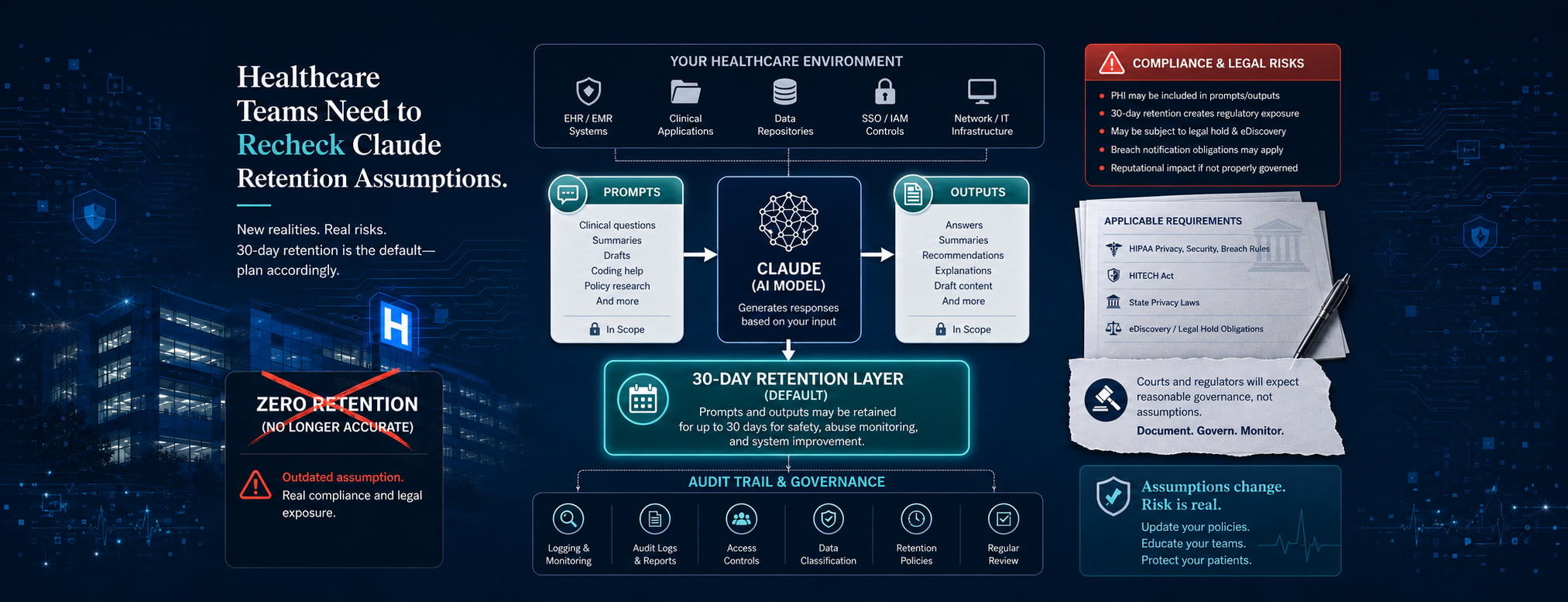
Healthcare Teams May Think Zero Retention Still Protects Them. It Does Not.
Medical application developers are moving fast to adopt newer foundation models.
Healthcare organizations are doing the same. Product teams want better reasoning. Clinical workflow teams want stronger assistants. Revenue cycle leaders want more automation. Digital health vendors want more capable AI in patient and operational tools.
But many teams are about to make a serious mistake.
They still think their Claude workflows are operating under a zero-retention assumption.
For Anthropic’s Covered Models, that assumption is no longer safe.
The Problem Healthcare Teams Are Missing
Anthropic now states that Covered Models, including Claude Fable 5 and Claude Mythos 5, require at least 30 days of retention for prompts and outputs. Anthropic also states that zero data retention is not available for those models.
That means healthcare developers and healthcare organizations cannot safely assume that the no-retention posture they may have relied on for earlier workflows still applies here.
If your medical application, internal clinical AI tool, patient communication workflow, coding assistant, documentation workflow, or healthcare operations system is sending sensitive data to one of these Covered Models, you need to understand exactly what retention policy applies before any PHI enters that system.
Because if your team gets that wrong, the problem is not theoretical.
You may have just routed protected information into an environment that retains prompts and outputs for 30 days when your developers, security leaders, or compliance team believed that was not happening.
Why This Is a Bigger Problem in Healthcare Than in Other Industries
In many sectors, a retention-policy change is a governance issue.
In healthcare, it can become a federal-law issue.
If protected health information is involved, the organization does not get to treat AI retention as a casual technical detail. HIPAA obligations, vendor oversight, business associate requirements, internal policies, and security controls all depend on teams knowing where protected data goes and how it is handled.
That is why this issue is so dangerous.
Not because “AI is scary.”
Because healthcare teams may continue building and deploying as if zero retention still applies when Anthropic has explicitly said that it does not for these Covered Models.
The Real Failure Is Governance
If this change catches a healthcare organization by surprise, that is not just a model-selection problem.
It is a governance failure.
It means one or more of the following likely broke down:
- Developers selected a model without re-checking retention terms.
- Compliance or legal teams were not brought into the workflow early enough.
- Security review did not validate what changed at the model-policy level.
- Product teams assumed that “Claude is approved” meant every Claude model had the same data-handling posture.
- Executives treated AI deployment as a feature decision instead of a regulated-data decision.
That last mistake is the one healthcare organizations keep making.
They evaluate model intelligence and workflow speed, then treat privacy and retention as secondary paperwork.
That is backward.
When PHI is involved, retention policy is not a footnote. It is part of the deployment decision itself.
Who Is Most at Risk
This warning applies directly to:
- medical application developers,
- health AI startups,
- hospital innovation teams,
- compliance leaders,
- healthcare CIOs and CTOs,
- clinical documentation and coding platform teams,
- revenue cycle vendors,
- patient engagement vendors,
- and internal teams experimenting with Claude in support, triage, documentation, or operations workflows.
If anyone in those groups assumes zero data retention still protects the workflow, they may be operating on the wrong premise.
What Healthcare Teams Need to Do Right Now
If your organization is using Claude in any medical or healthcare-related application, stop assuming prior retention controls still apply.
Audit these questions immediately:
- Are any Covered Models being used anywhere in production, staging, prototyping, testing, or internal experimentation?
- Has the team confirmed whether those models now require 30-day retention of prompts and outputs?
- Has legal or compliance reviewed whether that retention posture is acceptable for the intended data?
- Has the organization confirmed whether PHI has already been sent through one of these Covered Models?
- Have internal AI-use policies been updated so developers and business users do not assume older data-handling rules still apply?
If the answer to any of those questions is “I don’t know,” that is the problem.
The Bottom Line
Healthcare organizations should not treat this as minor documentation.
This is a control failure waiting to happen.
Anthropic has made clear that Covered Models do not operate under zero data retention. Prompts and outputs are retained for at least 30 days. If healthcare developers or healthcare organizations miss that change and send PHI anyway, they could create serious compliance exposure before anyone realizes the assumption changed.
The harsh truth is simple:
If your healthcare AI governance depends on people casually assuming retention settings, your governance is not real.
This is exactly the kind of mistake that puts medical AI deployments, patient data, and regulated workflows at unnecessary risk.
Healthcare teams need to stop treating retention as a technical detail and start treating it as a legal and operational decision.