The Difference Between AI Coding Assistance and Autonomous Coding
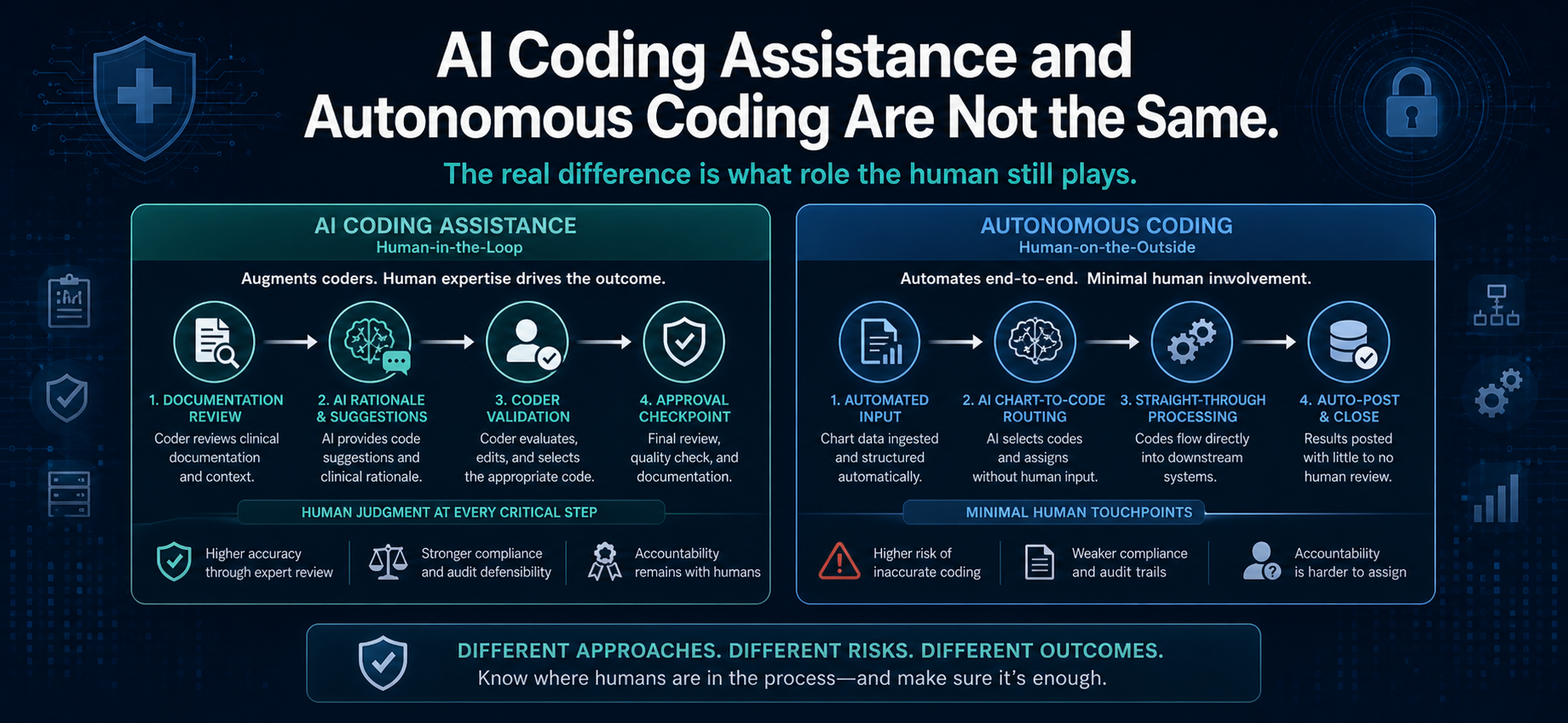
Healthcare buyers keep using one phrase as if it explains everything:
AI coding.
It does not.
That phrase now covers multiple product categories with very different workflow assumptions, risk profiles, and human-review expectations.
That is one of the biggest reasons buying conversations around medical coding AI still get confused.
One label, different operating models
When organizations say they are evaluating “AI for coding,” they may be talking about very different things:
- tools that suggest codes for human validation,
- tools that help reviewers compare documentation and coding logic,
- tools that triage exceptions or inconsistencies,
- tools that support CDI or pre-bill review,
- or tools that market autonomous code assignment for selected workflows.
Those categories are not interchangeable.
They ask different questions of the workflow.
Most importantly, they assign different roles to the human reviewer.
What AI coding assistance really means
AI coding assistance usually means the software supports a human reviewer rather than trying to remove one.
That support may include:
- surfacing likely code options,
- pointing to documentation support,
- comparing chart content and coding logic,
- highlighting variance or weak support,
- or helping the reviewer move faster through routine cases.
In this model, the human remains accountable for the final decision.
That is often a better fit for healthcare organizations that care about defensibility, training, consistency, and audit preparedness.
What autonomous coding means
Autonomous coding usually refers to workflows where the system is intended to assign codes with minimal or no human touch on qualified encounters.
That model may make sense in tightly defined environments where:
- documentation quality is consistent,
- workflow boundaries are narrow,
- exception handling is well designed,
- and the organization is comfortable with the control model.
But it is a different purchase.
It is not just “better AI coding assistance.”
It is a different operating philosophy.
Why buyers get this wrong
The problem is not that one category is always right and the other is always wrong.
The problem is category mismatch.
Teams run into trouble when they buy one model while expecting the behavior of another.
For example:
- a coding manager may want support for complex-case review,
- a compliance leader may want visible rationale and auditability,
- a revenue cycle executive may want throughput gains,
- and IT may want the lowest-friction deployment model possible.
Those priorities do not always point to the same kind of product.
The real decision point
The most important question is simple:
What role is the human still expected to play?
That question cuts through a lot of AI marketing noise.
It helps buyers clarify:
- whether the tool is a support layer or an automation layer,
- whether the team needs explainability or straight-through processing,
- whether the priority is defensibility or throughput,
- and whether the workflow is ready for the level of autonomy being proposed.
Why this matters for Code Sense and Audit Sentinel
This distinction creates a useful positioning lane.
Code Sense should be positioned as assistive coding review with justification and support visibility.
Audit Sentinel should be positioned as audit intelligence and coding-risk review with accountable human oversight.
Neither needs to compete by sounding more autonomous than the market.
In many buying contexts, the smarter message is the opposite:
clarity, control, rationale, and reviewer visibility.
Final thought
AI coding assistance and autonomous coding are not just different feature sets.
They are different answers to a more important question:
Who is supposed to make the final judgment, and what support do they need to make it well?
That is the distinction healthcare buyers should understand before they buy.