What Healthcare Leaders Get Wrong About AI and HIPAA in Medical Coding
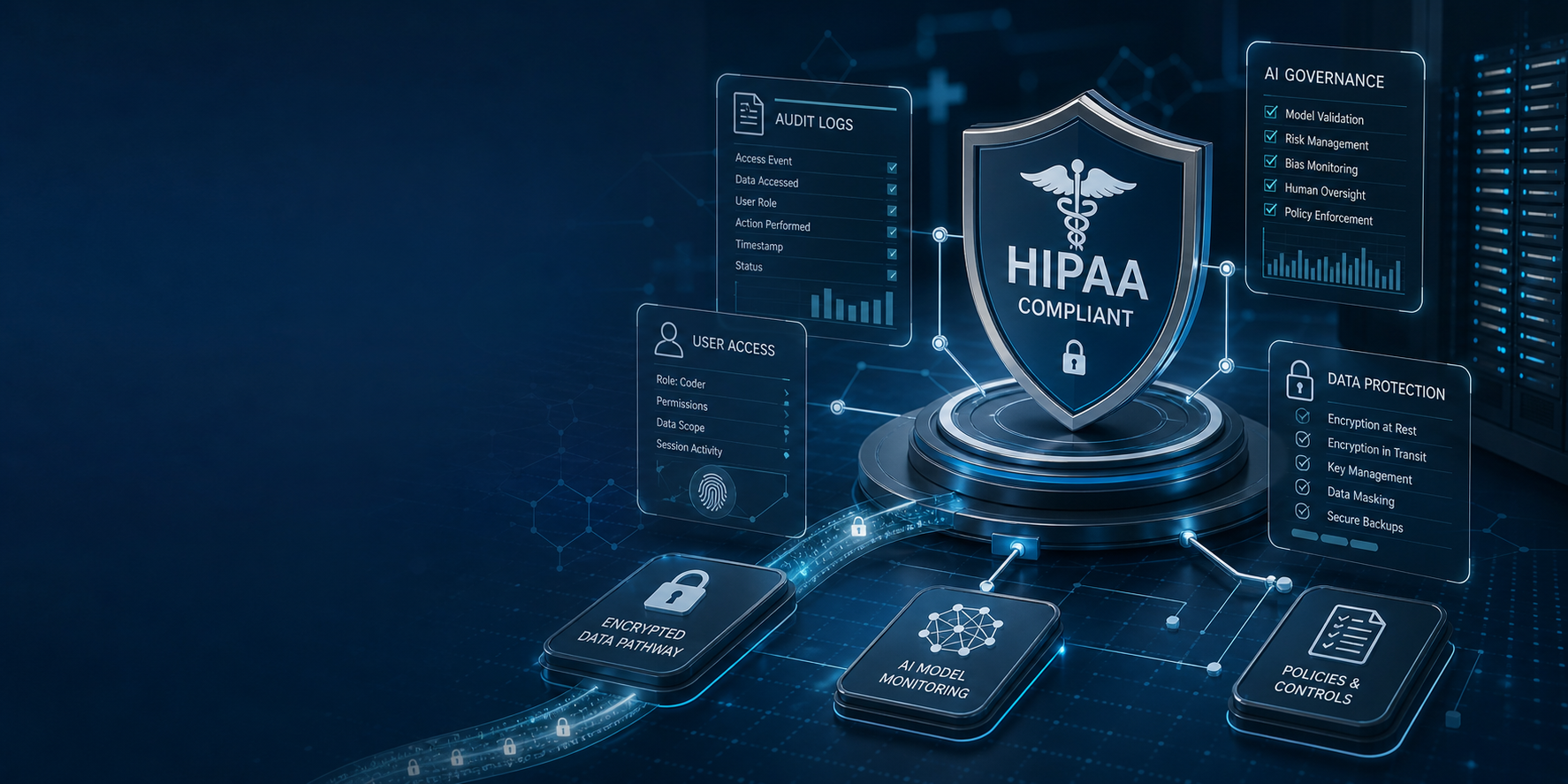
Healthcare leaders are moving quickly on AI.
That part is obvious.
What is less obvious is how often AI is still being evaluated with the wrong governance lens.
In medical coding, documentation review, and audit workflows, many organizations still talk about AI as if it were just another productivity tool.
It is not.
If protected health information is involved, AI becomes a privacy, security, contracting, and accountability issue before it becomes a productivity story.
That is where many organizations get the conversation wrong.
The wrong question
The wrong question is:
“Can we use AI in medical coding?”
That question is too broad to be useful.
The better question is:
“Under what controls are we using it, and what happens to PHI when we do?”
That shift matters because the risk is not simply “AI.” The risk comes from uncontrolled use, unclear vendors, bad retention practices, weak logging, poor access controls, or teams using public tools in ways leadership never intended.
Why public AI and healthcare AI are not the same thing
This is one of the most important distinctions to make internally.
Publicly available AI tools are not the same as healthcare-grade AI tools governed under proper contracts and organizational controls.
That difference is not marketing language. It is operational reality.
If a tool creates, receives, maintains, or transmits PHI on behalf of a covered entity or business associate, that relationship carries consequences:
- legal consequences,
- privacy consequences,
- security consequences,
- and procurement consequences.
Healthcare organizations should stop treating those differences like fine print.
Why a BAA is necessary but not enough
A business associate agreement matters. It is foundational.
But it is not the end of the review.
Leaders should still ask:
- What data is retained?
- How long is it retained?
- Who can access it?
- Are unique users enforced?
- Is activity logged and reviewable?
- Are subcontractors bound under the same obligations?
- How is data returned or destroyed at termination?
- What is the incident response process?
Those questions move the conversation from “Do we have a contract?” to “Do we have control?”
That is the better standard.
The hidden problem: shadow AI
Formal procurement is not the only risk.
In many organizations, the bigger immediate risk is shadow AI.
That happens when staff use a public or unapproved tool because it is easy, fast, and available before leadership has built a formal path for approved use.
This is exactly why AI governance cannot wait until after broad experimentation starts.
If the organization does not create a clear approved path, teams will often create their own unofficial one.
That is where preventable exposure begins.
Why this matters in coding and audit work
Coding and audit workflows are especially sensitive because they involve some combination of:
- clinical documentation,
- billing logic,
- reimbursement implications,
- compliance review,
- and accountable human decisions.
That means a weak tool governance model does not just create technical risk.
It creates organizational risk.
A team might end up relying on outputs it should not trust, storing information in ways leadership did not approve, or losing visibility into who did what and when.
That is not a productivity win.
That is a control failure.
What better governance looks like
Stronger organizations do a few things early:
They define approved and prohibited AI use.
They separate public tools from enterprise healthcare tools.
They require formal review for any tool that touches PHI.
They include compliance, privacy, security, and IT in vendor review.
They document retention, access, escalation, and incident processes.
They make accountability clear.
Most importantly, they do not treat healthcare AI like a side experiment once PHI is involved.
Where Code Sense and Audit Sentinel fit
This topic creates a strong positioning lane for both products.
Code Sense and Audit Sentinel should be framed as governed healthcare AI tools designed for controlled review workflows, not as consumer-style AI shortcuts.
That means messaging should consistently emphasize:
- human review,
- privacy-conscious deployment,
- accountable workflows,
- vendor-managed controls,
- and support for defensible coding and audit processes.
That tone is more credible than trying to sound like a generic AI startup.
Final thought
Healthcare leaders do not need to fear AI.
But they do need to stop treating it casually.
In coding and audit workflows, the question is not just whether the tool saves time.
It is whether the organization can explain how the tool is governed, how the PHI is protected, and who remains accountable for the final decision.
That is the real maturity test.