Why AI Medical Coding Fails When It Ignores Workflow
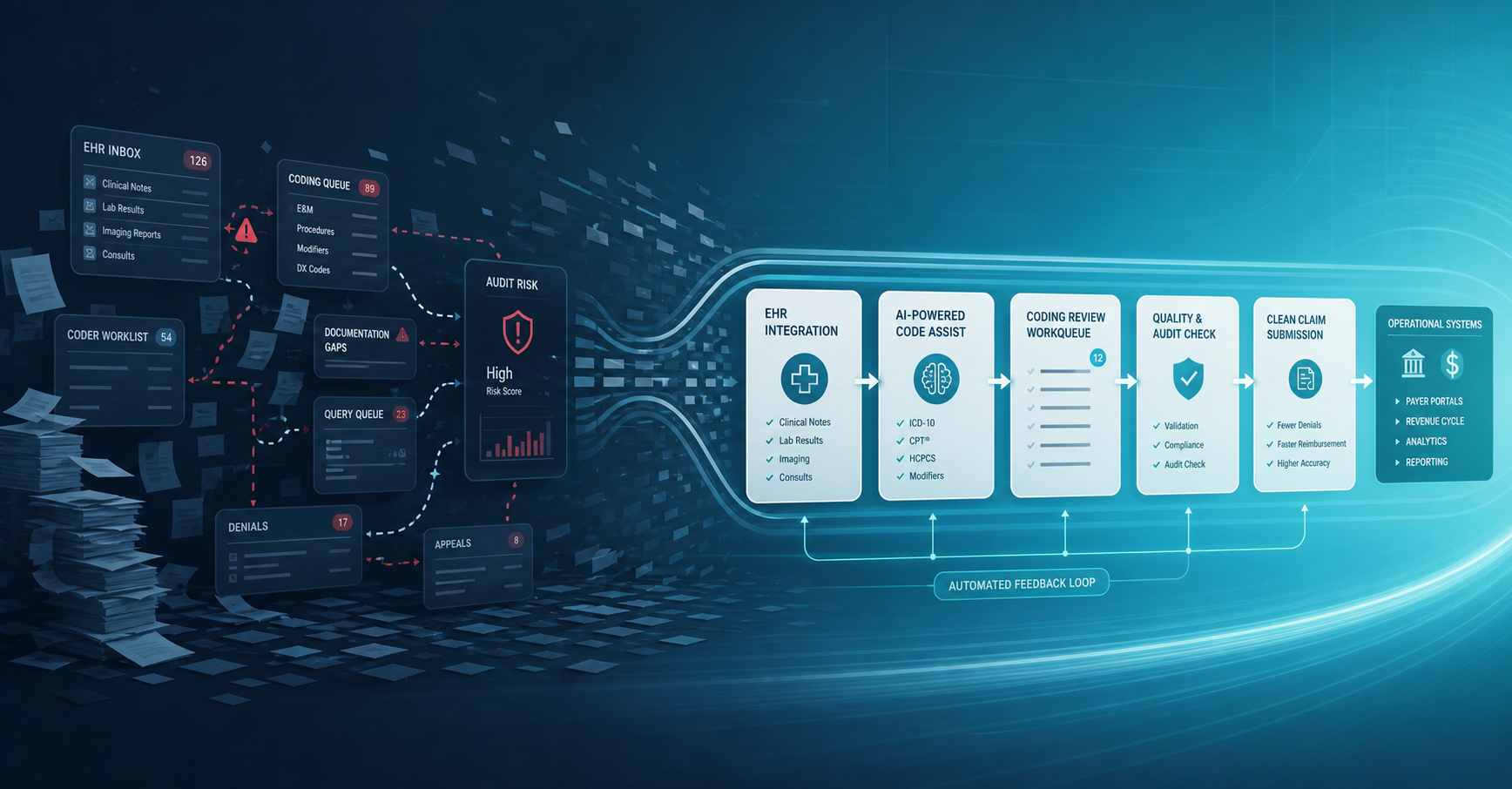
Most conversations about AI medical coding start in the wrong place.
They start with model performance.
How accurate is the tool?
How fast is it?
How many charts can it process?
Those questions matter. But they are not the first questions healthcare organizations should ask.
The first question should be simpler:
Will this tool fit the workflow our team actually lives in every day?
That question matters because healthcare does not adopt technology in a vacuum. Coding teams, auditors, compliance leaders, and revenue cycle staff already work inside established systems, timing rules, queue structures, and review habits. If a tool interrupts that flow, even a strong model can become an operational failure.
The demo problem
AI coding tools often look great in controlled demos.
In a demo, the chart is clean. The data is ready. The handoff is simple. The user path is short. The result appears fast and neat.
Real production environments are different.
Real workflows involve:
- incomplete documentation,
- variable chart quality,
- different specialty patterns,
- edge cases that need escalation,
- split review responsibilities,
- payer-specific concerns,
- and time pressure from pre-bill and post-bill deadlines.
That is why a tool that looks elegant in a product demonstration can feel frustrating in live use.
What workflow failure actually looks like
Workflow failure is not always dramatic.
Usually it shows up in smaller ways first:
- coders need to open another screen to see the AI output,
- the tool does not pull enough documentation context,
- reviewers need to manually reconstruct why a recommendation was made,
- exceptions are harder to handle than routine charts,
- auditors cannot compare chart support and suggested logic cleanly,
- or the team starts using the tool only selectively because it slows them down.
At that point, the AI is no longer a support layer. It becomes another piece of work.
That is the moment adoption starts to erode.
Why this matters in coding and audit workflows
Medical coding is not just a classification task. It is a workflow task.
The work depends on timing.
Sometimes the value is in pre-bill review.
Sometimes it is in concurrent chart review.
Sometimes it is in retrospective audit.
Sometimes it is in education and feedback after patterns have already surfaced.
Those are not the same workflow.
A tool that helps in retrospective audit may not help in live coder review. A tool that works well for routine coding support may be less helpful when an audit team needs to compare documentation support, final code selection, and review rationale.
That is why healthcare organizations should stop evaluating these products as if they all solve the same problem.
The real buying question
When healthcare leaders evaluate AI coding tools, they often lead with:
“How accurate is it?”
That is understandable, but incomplete.
A better sequence is:
- Where in the workflow will this tool be used?
- Who is supposed to act on the output?
- What still requires human review?
- How much context does the reviewer see?
- Does the tool reduce friction or add it?
Those questions reveal whether the product can succeed in real operations.
Accuracy matters. But a tool that disrupts queue flow, adds clicks, or makes exceptions harder to review can still fail even if the model itself is technically strong.
What better workflow design looks like
The best AI support tools in this category tend to do a few things well.
They reduce context switching.
They surface the relevant documentation clearly.
They fit naturally into the review point where the team already works.
They separate routine support from complex escalation.
They make it obvious when human judgment is still required.
In other words, they help the team work better without asking the team to redesign itself around the software.
That is the real standard.
Where Code Sense and Audit Sentinel fit
This is where workflow-first positioning matters.
Code Sense should be framed as coding review support that helps teams evaluate chart logic and justification without replacing coder judgment.
Audit Sentinel should be framed as an audit intelligence layer that helps teams identify inconsistency, weak support, and coding risk at the right review stage.
Both products are strongest when they are presented as tools that fit into healthcare review workflows, not as abstract AI engines.
Final thought
Healthcare organizations do not need more AI theater.
They need tools that reduce friction, support defensible decisions, and fit the reality of coding and audit work.
That is why workflow fit is not a secondary implementation detail.
It is one of the main reasons AI medical coding succeeds or fails.