Why Every AI Coding Recommendation Needs a Rationale
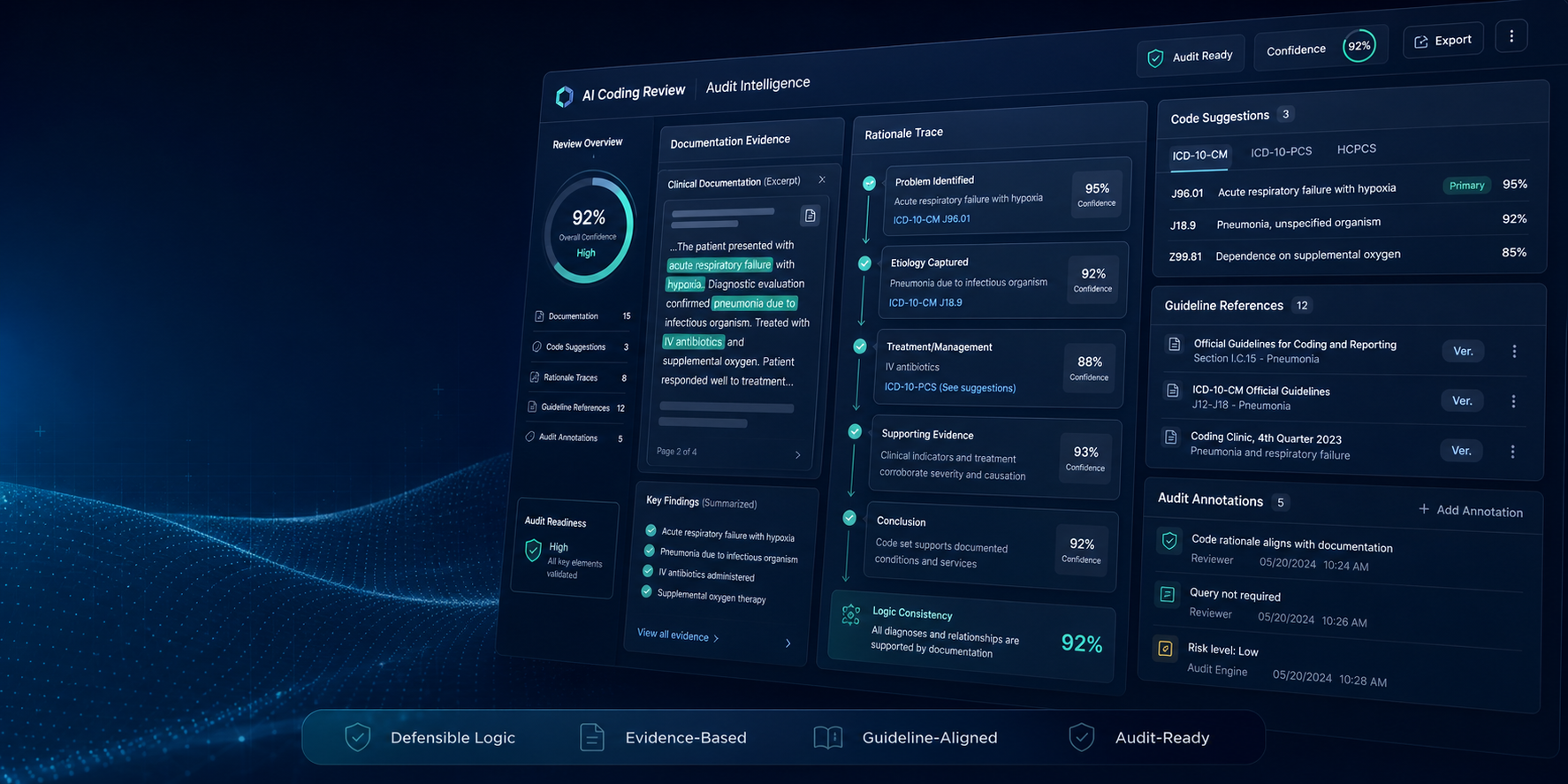
Healthcare teams are being asked to trust more AI-generated outputs every month.
That trust question matters in medical coding more than most categories.
Why?
Because a code suggestion is not the same thing as a defensible coding decision.
That difference is where many AI products will either earn trust or lose it.
The output is not the whole product
When people evaluate AI coding tools, they often focus on the visible output:
- the code suggestion,
- the level recommendation,
- the risk flag,
- the score,
- or the chart summary.
That is understandable. It is the easiest part to compare.
But in practice, the visible output is not the whole product.
The harder and more important question is:
What reasoning can the reviewer actually see?
If the answer is “not much,” then the tool is asking the human reviewer to trust a black box at exactly the point where documentation support and coding logic matter most.
Why rationale matters
Rationale matters because coding teams are not only trying to move faster.
They are trying to answer harder questions:
- Does the documentation support the recommendation?
- What part of the record matters most here?
- Is this a strong recommendation or a weak one?
- What still depends on coder or auditor judgment?
- Would this hold up under review later?
Those questions do not disappear just because software produced an answer quickly.
In many cases, they become more important.
That is why recommendation-only AI often creates a strange result:
It looks efficient at first glance, but it quietly pushes review burden downstream because someone still has to reconstruct the logic.
Rationale improves trust
Trust is built differently in healthcare than in consumer software.
In consumer products, people may accept a useful result even if they do not fully understand how it was produced.
In coding, audit, and compliance workflows, that is much harder.
People need to know:
- what evidence was considered,
- what documentation was linked to the suggestion,
- and what assumptions were made.
That is especially true when a coding decision affects reimbursement, audit exposure, training, or internal consistency.
Visible rationale helps the reviewer make a better judgment call.
It also makes the product easier to trust because the human is not being asked to simply accept the output as final truth.
Rationale improves education
This is one of the most overlooked benefits of rationale-first design.
A recommendation teaches less than an explanation.
If a tool simply suggests a code, the reviewer may accept it or reject it, but the opportunity for broader learning is limited.
If the tool shows why the recommendation was made, the output becomes reusable:
- for coder education,
- for physician documentation feedback,
- for audit comparison,
- for explaining repeat variance,
- and for training newer staff.
That makes rationale more than a trust feature.
It becomes a performance improvement feature.
Rationale improves audit defensibility
Audit and compliance teams do not only care whether a recommendation seems plausible.
They care whether the reasoning behind it can be reviewed, challenged, and explained.
That is a different standard.
A visible rationale helps teams compare:
- documentation support,
- code selection logic,
- reviewer decisions,
- and recurring variance patterns.
Without that visibility, the AI output becomes harder to defend because the logic behind it is hidden or too shallow to inspect meaningfully.
In other words, rationale is part of defensibility.
Where this matters most
This matters most in the exact places where coding complexity and scrutiny tend to rise:
- E/M review,
- documentation support review,
- edge-case chart evaluation,
- retrospective audit,
- inconsistency detection,
- and education workflows.
Those are not environments where “just give me the answer” is enough.
They are environments where the answer needs support.
Where Code Sense and Audit Sentinel fit
This is one of the clearest positioning opportunities for Brightcore.
Code Sense should be described as more than code suggestion support. Its value is strongest when it helps the reviewer understand the coding logic and supporting documentation behind the recommendation.
Audit Sentinel should be described as an audit intelligence layer that helps teams compare support, identify weak rationale, and surface patterns of inconsistency or risk.
That message is more credible than promising magic accuracy.
It also aligns much better with how healthcare buyers actually think about accountability.
Final thought
The healthcare AI tools that win long-term trust will not be the ones that simply produce faster answers.
They will be the ones that help qualified professionals review, understand, and defend those answers.
That is why every AI coding recommendation needs a rationale.
Not because explanation sounds nice.
Because in coding, audit, and compliance review, visible logic is part of the product.